Author Archive

Blind References

Friday, May 22nd, 2009

Definition:

Blind References:  A subject, name or series title authority record contains a blind reference if there is no heading in the database corresponding to the valid form stored in the authority file.  Usually the last bibliographic record that contained the heading has been deleted.  These authority records are to be deleted from your ILS system authority file.

On a library’s ILS system the blind reference will either not be included in the authority index or will be included in the index with zero hits (bibliographic connections) associated with it. When an authority file is in place on an ILS system only the authorized heading 1XX or the see also reference 5XX of the authority record can be a blind reference. The nature of the see reference 4XX always points to the authorized heading 1XX and can not be a blind reference though on some ILS systems a search on the see reference will have the same result as a search on the authorized heading if the authority record is a blind reference. That is no bibliographic record will be found.

Example of a Blind Reference: Note the 0 that is in yellow is a blind reference.  The other 0 under Topographic Brain mapping is a see reference.

Subject                                                                                    Titles

Topographic brain mapping.                                      0 

  • See: Brain mapping.                                           1

Topographic maps – Databases. 2

Topographic maps — Databases — Software. 0

Topographic maps — Software. 2

How a Blind Reference gets on a Library’s ILS system

There are several ways an ILS system produces Blind References.  The following is a list of a few.

1.      If a library deletes the last bibliographic record associated with an authority it will become a blind reference unless it is removed from the system.

2.      If a new authority does not match up to an existing authorized bibliographic heading it will become a blind reference.

3.      If an authority automation vendor delivers an authority that the library no longer owns it will become a blind reference.

The first description of how a blind reference gets on a library system can be avoided by making sure that you delete any authority associated with a deleted bibliographic record.  Most ILS systems automatically generate a report of these occurrences.

The second blind authority problem occurs during the automation authority control process.  In the past these had to be reconciled or connected through a semi automated and sometimes time consuming process.  Backstage now has a process called “Heading Tracker” that makes manual reconciliation almost obsolete.

The last blind authority problem also occurs during the automated authority control process but can be easily remedied by routine maintenance described below.

Maintenance:

The library needs to send their authority deletes to their automation vendor.  There is no automatic removal from the master authority file your vendor keeps with the library’s authority database.  The process can be part of a simple routine maintenance. Most ILS systems automatically generate a file of deleted authority records that can be accessed through reports.  If a list of the deleted records is sent to Backstage we can remove them from your master authority file.  That list should include the control number (001) of the authority record.

Announcing: Heading Tracker a death date fix and more

Wednesday, April 15th, 2009

Backstage Library Works is pleased to announce Heading Tracker, a much-anticipated enhancement to the MARS Authority Control Service. This enhancement is free to MARS clients using ongoing authority control services — Current Cataloging, Notification Services, or both.

In response to requests from many of our clients, the MARS team has developed this Heading Tracker enhancement to bridge the gap between antiquated and updated headings provided by the Library of Congress, when LC does not formally establish a see reference to connect the old heading to its new version.

This gap is most often noticeable in the problem whose solution we’ve long referred to as the ‘death date fix’ — where LC adds a death date to a name heading, causing a disconnect between your records with open death dates and the new authorized headings with closed dates — but it shows up in changes to uniform titles and other headings as well.

To resolve this problem, the Heading Tracker subroutine automatically generates a see reference (4XX) in your authority record, using the old Library of Congress heading. This see reference is marked as a local tag with a subfield ‘5’ and Backstage’s institution code: $5UtOrBLW. The see reference is also prefaced with a subfield ‘w’ and the appropriate coding to hide the reference from the library’s public access module: $wnnea.

An example of a see reference (4XX) correcting for the addition of a death date would look like this:
(Note that the $w and $5 are highlighted in yellow.)

001 __ n 50000918
003 __ DLC
005 __ 20090218072944.0
008 __ 800208n| acannaabn |a aaa
010 __ $an 50000918
035 __ $a(OCoLC)oca00036619
040 __ $aDLC$beng$cDLC$dOCoLC
100 1_ $aParker, Fan,$d1908-2004
400 1_ $aPockrose, Fania M.,$d1908-2004
400 1_ $wnnea$aParker, Fan,$d1908-$5UtOrBLW
670 __ $aOCLC, Feb. 17, 2009$b(hdgs.: Parker, Fan, 1908- ; Parker, Fan, 1908- ; usage: Fan Parker)

As with most functions of MARS 2.0, options for the Heading Tracker can be selected in your profile. For instance, if you want to display in the Public Access module, we can do that. If you want the enhancement, but you would rather not include undifferentiated or generic headings, we can specify that, too. The standard options available for this feature are listed below.

  • Display in public access, or not. The default will be to not display.
  • Create an undifferentiated or generic see reference, or not. The default is to create the reference.
  • Clean up see references (other than a 430) by making the second indicator of that tag blank, in compliance with Library of Congress standards. The default is to not adjust the LC-provided indicator.
  • Run a second file without Heading Tracker data, directly after the first file, to remove the Backstage-created see references. This provides the connection between old and new headings when importing the files to your ILS, but removes the old references when the second file is loaded. The default is to not provide a second file.

If there are options that you are interested in that are not listed above, let us know and we’ll work to accommodate your needs.

To incorporate the Heading Tracker process on your next Current Cataloging or Notification run, please contact your MARS project manager.

The MARS staff hopes this enhancement will further streamline your automated authority control process. Your input is always appreciated. Contact us if you have questions or concerns.

To learn more, ask questions, or make comments on this enhancement, click over to the Heading Tracker thread on our Control Center Community Forum.

Yours,

John Reese
Vice President, Authority Services
Backstage Library Works
1-800-288-1265 x.249
jreese@bslw.com

Loading Replacement Authorities into Polaris

Thursday, April 9th, 2009

An update from Polaris Integrated Library Systems – $z in the 010 tag

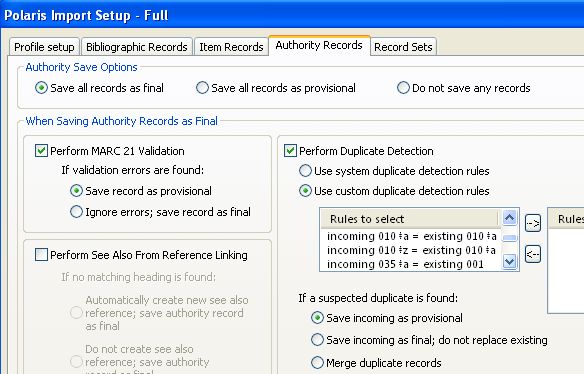
Polaris ILS versions prior to version 3.5 do not allow an incoming authority record to overlay if the Library of Congress authority record is replaced by an older version of that authority record.  When a newer record replaces an older record at the Library of Congress a “$z” with the old authority control number is added to the 010 of the new record.  This tells the library that there was an old version of this record and it has been replaced with this new version.  Prior to Polaris version 3.5, the Polaris system would not recognize the $z as the old record and the overlay would not take place.

According to Brad Rogers, Director of Implementation Services at Polaris, version 3.5 addresses this issue with a new dedupe rule added specifically for authority record importing.  Version 3.5 is slated for release by Polaris in just a few weeks.  The following Polaris importing setup screen reflects the change.

Screenshot showing new import rules allowed by the soon to be released latest Polaris update.

Screenshot showing new import rules allowed by the soon to be released latest Polaris update.

Always Load in Correct Order

Friday, March 20th, 2009

WHY IT’S A GOOD IDEA TO LOAD YOUR AUTHORITIES IN THE ORDER WE PROCESSED THEM

We have often had clients ask us in what order they should load their authorities, if they have several groups to load.  Perhaps you’ve found yourself in the situation where you haven’t loaded your last set of authority updates and now you’ve sent in new bibliographic records to be processed, or maybe your next scheduled update has arrived.  You find yourself looking at two or more batches of authorities and you wonder, “Does it really matter which goes first?”  Absolutely!  And here’s why:


    *  Say you had a scheduled authority update in December, but things went crazy busy and you haven’t had time to load those authorities yet.  Now it’s March and you have a large group of new bibliographic records that need processing, so you send them in.  Thinking you can save time by loading both the December updates and the bibliographic authorities at the same time, you wait for the new group to be returned.  But now … which to load first?  You should load the December updates first.  Example:

    *  You have a heading for Doe, John,$d1955-   and sometime last year LC updated that to Doe, John Joseph,$d1955- (and if we’re lucky, LC added the “old” heading as a 400 see-reference).  This changed authority would deliver with the December group you hadn’t loaded yet.

    *  Now you’ve sent in your bib records and in there is the heading for Doe, John,$d1955-  .  However, between December and today’s date LC decided to edit the record again and they put out a new authority with the new heading of: Doe, John J.,$d1955- (and still kept the original “old” heading of Doe, John,$d1955-  in a 400 see-reference tag).

    *  With the processed bibs you’d get back the very newest authority for Doe, John J.,$d1955-, which is what you’d want in your system.

    *  But if you decide to load the bibliographic records and associated authorities first and the December authority updates second, the middle version of Doe, John Joseph,$d1955-  (from the December updates) would overwrite the newest authority sent with the bibs, and you would be stuck with an older, not current LC version of this heading.

Which is why it’s always wisest to load oldest-to-newest, when you’re working with several projects at once.

Written by: Judy Archer

Understanding the MARC Structure

Monday, March 16th, 2009

Underneath the MARC records that we all know and love is a somewhat cryptic structure that tells our systems how to read the record. Luckily, this structure rarely gets corrupted, but when it does, it’s good to have a basic understanding of how to read and understand a MARC Format.

The MARC format is a text based format, meaning you can open it with a text editor. It is probably a good idea to only open a few (or only one!) record in a text editor, because it’s very difficult to read otherwise.

Every MARC record starts with a leader, the leader gives your system information about the record, including how big it is and what type of a record it is. Next is what is called a directory. Just like a normal directory, it tells you what tags are in it, and where the data for each tag is located.

This is how a leader is defined for a Bibliographic Record:

Leader: 

Position | Description              | Explination
------------------------------------------
00-04 | Record Length               = This is how long the record is
05    | Record Status               = Is the record new, changed or deleted
06    | Type of record              = Authority, Book, Computer file, etc.
07    | Bibliographic level         = Monograph/Serial/etc.
08    | Type of control             = Archival or not
09    | Character coding scheme     = MARC8 or UTF8
10    | Indicator count             = # of indicators each tag has
11    | Subfield code count         = # of subfield codes that make up 1 subfield
12-16 | Base address of data        = The byte where actual record data begins
17    | Encoding level              = Level of encoding/cataloging
18    | Descriptive cataloging form = AACR2
19    | Multipart resource record level = # (blank)
20    | Length of the length-of-field = # of bytes to store how long each tag is
21    | Length of the starting-character-position = # of bytes to store where tag begins
22    | Length of the implementation-defined portion = Rarely used
23    | Undefined                   = Not used

Looking at a leader can be confusing, but it’s also the only way to find some problems.

Here is an example record, as it may appear on your screen:
001 __ 3180021
005 __ 20050216201852.0
008 __ 040805s2005    nyu      b    001 0 eng 
010 __ ▼a  2004018260
020 __ ▼a0415971675 (alk. paper)
035 __ ▼a(DLC)  2004018260
040 __ ▼aDLC▼cDLC▼dDLC▼dCaONFJC▼dOrLoB-B
043 __ ▼an-us—
050 00 ▼aPS374.H56▼bO73 2004
082 00 ▼a813/.5409358▼222
090 __ ▼aPS374.H56▼bO73 2005
100 1_ ▼aOrbán, Katalin.
245 10 ▼aEthical diversions :▼bthe post-holocaust narratives of Pynchon, Abish, DeLillo, and Spiegelman /▼cKatalin Orbán.
260 __ ▼aNew York :▼bRoutledge,▼c2005.
300 __ ▼aix, 209 p. ;▼c24 cm.
440 _0 ▼aLiterary criticism and cultural theory
504 __ ▼aIncludes bibliographical references (p. 193-205) and index.
505 00 ▼gCh. 1.▼t”Mauschwitz” : monsters, memory, and testimony — ▼gCh. 2.▼tFamiliarity and forgetfulness in Walter Abish’s fiction — ▼gCh. 3.▼tPinpricks on the Ars(e) Narrandi : liminality and oven-games in Gravity’s rainbow.
600 10 ▼aPynchon, Thomas▼xKnowledge▼xHolocaust, Jewish (1939-1945)
600 10 ▼aSpiegelman, Art▼xKnowledge▼xHolocaust, Jewish (1939-1945)
600 10 ▼aAbish, Walter▼xKnowledge▼xHolocaust, Jewish (1939-1945)
600 10 ▼aDeLillo, Don▼xKnowledge▼xHolocaust, Jewish (1939-1945)
650 _0 ▼aAmerican fiction▼y20th century▼xHistory and criticism.
650 _0 ▼aHolocaust, Jewish (1939-1945), in literature.
650 _0 ▼aJudaism and literature▼zUnited States▼xHistory▼y20th century.
650 _0 ▼aWorld War, 1939-1945▼zUnited States▼xLiterature and the war.
650 _0 ▼aEthics in literature.
650 _0 ▼aJews in literature.
852 0_ ▼bkr▼hPS374.H56▼iO73 2005
856 41 ▼3Table of contents▼uhttp://www.loc.gov/catdir/toc/ecip0421/2004018260.html
949 __ ▼aApproval▼b1628024-35▼c67.20▼d1▼i20027328▼jUSD▼tBook

Now, if we are to take a look at the actual MARC structure, it looks like this (when looking at an underlying MARC record, you may not be able to see all of the special characters like end of field and end of record marks, but they are there):

01872cam a2200397 a 450000100080000000500170000800800410002501000170006602000280008303500220011104000360013304300120016905000240018108200

210020509000240022610000210025024501180027126000340038930000250042344000430044850400640049150502240055560000620077960000

620084160000600090360000590096365000590102265000500108165000660113165000650119765000260126265000240128885200280131285600

7801340949005601418318002120050216201852.0040805s2005    nyu      b    001 0 eng    a  2004018260  a0415971675 (alk. paper)  a(DLC)  2004018260  aDLCcDLCdDLCdCaONFJCdOrLoB-B  an-us—00aPS374.H56bO73 200400a813/.5409358222  aPS374.H56bO73 20051 aOrbán, Katalin.10aEthical diversions :bthe post-holocaust narratives of Pynchon, Abish, DeLillo, and Spiegelman /cKatalin Orbán.  aNew York :bRoutledge,c2005.  aix, 209 p. ;c24 cm. 0aLiterary criticism and cultural theory  aIncludes bibliographical references (p. 193-205) and index.00gCh. 1.t”Mauschwitz” : monsters, memory, and testimony — gCh. 2.tFamiliarity and forgetfulness in Walter Abish’s fiction — gCh. 3.tPinpricks on the Ars(e) Narrandi : liminality and oven-games in Gravity’s rainbow.10aPynchon, ThomasxKnowledgexHolocaust, Jewish (1939-1945)10aSpiegelman, ArtxKnowledgexHolocaust, Jewish (1939-1945)10aAbish, WalterxKnowledgexHolocaust, Jewish (1939-1945)10aDeLillo, DonxKnowledgexHolocaust, Jewish (1939-1945) 0aAmerican fictiony20th centuryxHistory and criticism. 0aHolocaust, Jewish (1939-1945), in literature. 0aJudaism and literaturezUnited StatesxHistoryy20th century. 0aWorld War, 1939-1945zUnited StatesxLiterature and the war. 0aEthics in literature. 0aJews in literature.0 bkrhPS374.H56iO73 2005413Table of contentsuhttp://www.loc.gov/catdir/toc/ecip0421/2004018260.html  aApprovalb1628024-35c67.20d1i20027328jUSDtBook

And here is a sample analysis of this record:

Leader: 

Position | Description              | Data
------------------------------------------
00-04 | Record Length               = 01872 : confirmend in a hex editor the record is this length
05    | Record Status               = c
06    | Type of record              = a
07    | Bibliographic level         = m
08    | Type of control             = # (blank)
09    | Character coding scheme     = a
10    | Indicator count             = 2
11    | Subfield code count         = 2
12-16 | Base address of data        = 00397 : confirmed in hex editor this is correct
17    | Encoding level              = # (blank)
18    | Descriptive cataloging form = a
19    | Multipart resource record level = # (blank)
20    | Length of the length-of-field portion = 4
21    | Length of the starting-character-position portion = 5
22    | Length of the implementation-defined portion = 0
23    | Undefined                   = 0
Directory: 

Tag | Field length | Starting character position
001 0008 00000
005 0017 00008
008 0041 00025
010 0017 00066
020 0028 00083
035 0022 00111
040 0036 00133
043 0012 00169
050 0024 00181
082 0021 00205
090 0024 00226
100 0021 00250
245 0118 00271
260 0034 00389
300 0025 00423
440 0043 00448
504 0064 00491
505 0224 00555
600 0062 00779
600 0062 00841
600 0060 00903
600 0059 00963
650 0059 01022
650 0050 01081
650 0066 01131
650 0065 01197
650 0026 01262
650 0024 01288
852 0028 01312
856 0078 01340
949 0056 01418| (56+1418 = 1474) 1474 = Ending field terminator below

Fields:
(For our convenience in readin the record we have replaced certain non-displayed fields with graphical representations)
| = field terminator (also used to terminate the directory)
$ = subfield code delimiter
^ = record terminator
_ = utf8 characters have been replaced by an undersore so the postions line up in a non-hex display

3180021|20050216201852.0|040805s2005    nyu      b    001 0 eng  |  $a  2004018260|  $a0415971675 (alk. paper)|  $a(DLC)  2004018260|  $aDLC$cDLC$dDLC$dCaONFJC$dOrLoB-B|  $an-us—|00$aPS374.H56$bO73 2004|00$a813/.5409358$222|  $aPS374.H56$bO73 2005|1 $aOrb__n, Katalin.|10$aEthical diversions :$bthe post-holocaust narratives of Pynchon, Abish, DeLillo, and Spiegelman /$cKatalin Orb__n.|  $aNew York :$bRoutledge,$c2005.|  $aix, 209 p. ;$c24 cm.| 0$aLiterary criticism and cultural theory|  $aIncludes bibliographical references (p. 193-205) and index.|00$gCh. 1.$t”Mauschwitz” : monsters, memory, and testimony — $gCh. 2.$tFamiliarity and forgetfulness in Walter Abish’s fiction — $gCh. 3.$tPinpricks on the Ars(e) Narrandi : liminality and oven-games in Gravity’s rainbow.|10$aPynchon, Thomas$xKnowledge$xHolocaust, Jewish (1939-1945)|10$aSpiegelman, Art$xKnowledge$xHolocaust, Jewish (1939-1945)|10$aAbish, Walter$xKnowledge$xHolocaust, Jewish (1939-1945)|10$aDeLillo, Don$xKnowledge$xHolocaust, Jewish (1939-1945)| 0$aAmerican fiction$y20th century$xHistory and criticism.| 0$aHolocaust, Jewish (1939-1945), in literature.| 0$aJudaism and literature$zUnited States$xHistory$y20th century.| 0$aWorld War, 1939-1945$zUnited States$xLiterature and the war.| 0$aEthics in literature.| 0$aJews in literature.|0 $bkr$hPS374.H56$iO73 2005|41$3Table of contents$uhttp://www.loc.gov/catdir/toc/ecip0421/2004018260.html|  $aApproval$b1628024-35$c67.20$d1$i20027328$jUSD$tBook|^

Ending field terminator    = 1474
Record terminator position = 1475

Summary
———————————
Ending field position = 1475
Base address of data  = 397

1475 + 397 = 1872 (Record Length)
The Significance of the Subfield w

Thursday, February 19th, 2009

One of the things we’re asked about occasionally is what the meaning of a $w (subfield w) is in See References in Authority Records (4XX tags). We hope this will help explain what the $w does.

The $w is a control subfield with up to four character positions. One-character alphabetic codes are used to describe special instructions that apply to the display of 4xx and 5xx fields. The definitions of the codes in subfield $w are dependent on the character position in which they occur. The coding of any character position mandates that each preceding character position contains a code or a fill character (|); succeeding character positions need not be used. For example, if $w/0 and $w/1 are not applicable but $w/2 is applicable, then $w/0 and $w/1 each contain code n (Not applicable) or a fill character (|). The n is used more often than the fill character.

We will use the following positions and codes to identify the references that our process adds to the LC authority records.

/2 – Earlier form of heading. We will use either of the following codes depending on which authority file (LC, MeSH, etc.) we found the former heading in.

  • e – Earlier established form of heading (national authority file) – We will use this for headings found in the LC Authority File
  • o – Earlier established form of heading (other authority file) – This will be used for headings found in other authority files.

/3 – Reference display. The following codes will be applicable in our process.

  • a – Reference not displayed
  • n – Not applicable – reference would display (If code n is applicable, subfield $w/3 need not be coded.)

Client libraries will be able to choose if they would like these added references to display or not and we will code the added reference accordingly.

$5 – Institution to which Field Applies. This subfield contains the MARC code of the institution or organization that has added a tracing, reference, or linking entry field to an authority file record. It is used for institution-specific information that may or may not apply to the universal use of the authority record.
We will identify these added references by adding a $5 with our institution code to them. i.e. $5UtOrBLW

So, a sample 4xx from a match made by our new process for a client that does NOT want the reference to display would look like:

4xx 0 $wnnea$aSome subject$xSubfield too$5UtOrBLW

It could look like this if they did want the reference to display:

4xx 0 $wnne$aSome subject$xSubfield too$5UtOrBLW

For more infomation on $w and $5, see the MARC21 Authority Format under the Tracings and References-General Information section at the following link: